A. Schrader’s Son
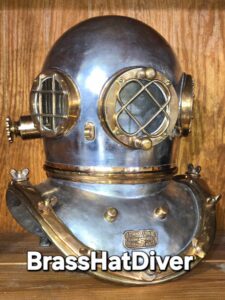
In 1840 a young mechanic named August Schrader arrived in New York from Hamburg, Germany. By the spring of 1844 he had saved enough money to purchase some machinery, and open a shop at 115 John Street in Manhattan. He was a maker of daguerreotype apparatus. Shortly after he went into partnership with Christian Baecher, who was a turner, a finisher of brass.
In 1846 Schrader took interest in an underwater race between divers off the battery in Lower Manhattan and after inspecting the diver’s equipment, he was convinced that he could improve the design, and manufacturing of the helmets. By 1849 had Schrader produced two helmets and sold them to the Union India Rubber Co. of New York for $12.00 each and in January 1850 Schrader sold the same company an air pump for $25.00.
By 1887, Schrader was in partnership with his son George. August retired in 1892, two years before his death. In 1892 George received a patent for a valve for pneumatic tires, and by 1904 the company was incorporated. In 1913 the company moved to Brooklyn, NY. In 1930, A. Schrader’s Son, Inc. became a subsidiary of the Scovill Manufacturing Company, with offices worldwide. In 1952, Scovill sold the A. Schrader’s Son, Inc. rights, trademark and tooling, drawings, etc. to Craftsweld Equipment Corporation, of Long Island City, NY. Craftsweld continued to produce Schrader helmets and other diving equipment, electing to use their brand name only. In 1999, Craftsweld sold the A. Schrader’s Son, Inc. business to Ray Mathieson, owner of Atlantic Diving Equipment Company, located in Bowie, MD. With Ray’s untimely passing in 2016, A. Schrader’s Son, Inc. found a new home and owner in Bucks County, PA.
A. J. Morse & Son
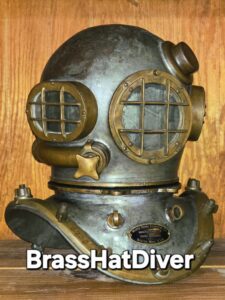
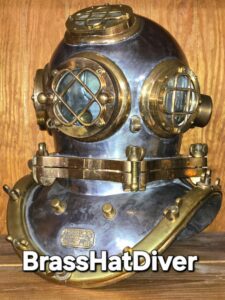
In 1837 the partnership of Fletcher and Morse was formed for the manufacturing of brass goods at the corner of Water and Congress Streets in Boston, Massachusetts, using the name Fletcher & Morse Co. After a number of years Mr. Fletcher retired and Andrew Morse began making diving helmets and air pumps.
In 1864 the company name was changed to Andrew J. Morse & Son and in 1881 Mr. Morse died, leaving his son, William F. Morse, to run the company. The company then expanded into manufacturing valves, fittings, nozzles, and water cannons for firefighting.
In 1905 William Morse retired and the business was given to his daughter and her husband, Elizabeth and Mark A. Lawton. They incorporated the company and Inc. was added to the name – Andrew J. Morse & Son Inc. The 1910 Morse catalog lists 221 High Street as the company address.
In 1939 William Farrell (owner of McKee Pile Diving Company), bought the company and continued to operate it in Boston, and in 1940 the name of Morse was then incorporated – Morse Diving Equipment Co, Inc.
DESCO
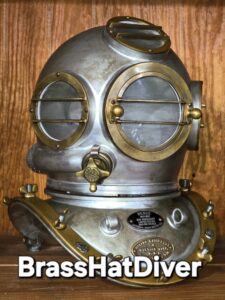
In 1935, a Milwaukee diver, Max Gene Nohl, had received national publicity as the result of his salvage operations on a sunken steamship, the “John Dwight.” This brought him to the attention of a Hollywood producer, Col. John D. Craig, who was interested in the possible salvage of the torpedoed Cunard liner, the “Lusitania,” which lay in 312 feet of water off the Irish Coast. At that time, no equipment or reliable techniques were available for diving operations at such a depth, and it was obvious that such a project would require both physiological experimentation and an advance in diving equipment design. Nohl had already been working on diving equipment to work at the Lusitania’s depth. Additional support equipment would need to be designed and built for the project. Nohl using the suit design from his thesis as a starting point began experimentation on building the necessary gear. Jack Browne worked with Nohl and Craig to get the equipment ready. Browne and Nohl worked together on the design of a new type of lightweight, self-contained diving suit. In April 1937 Max Nohl contacted Dr. End about his development of Helium/ Oxygen decompression tables. Dr. End suggested using the recompression chamber in the basement of the Milwaukee County Hospital to test their theories. They worked with Dr. End to explore the promising possibility of preventing nitrogen narcosis and Caisson Disease (the Bends) by having the diver breathe a mixture of helium and oxygen rather than air.
The first result of this collaboration was the forming of Diving Equipment & Salvage Company (DESCO) as the manufacturer of the newly designed diving equipment. Mr. Norman Kuehn, a Milwaukee businessman, largely financed the new corporation. Browne and Nohl became its first full-time employees. Browne was also one of its shareholders. The company was set up in the rear of Kuehn Rubber Company on North 4th Street in Milwaukee. Norman Kuehn was made Vice-President of the firm.
The second result was that, On December 1, 1937 in the cold waters of Lake Michigan, Max Nohl succeeded in diving to a depth of 420 feet, breaking a depth record which had been held by a U.S. Navy diver Frank Crilley, since 1915. Nohl accomplished this feat using DESCO’s new diving equipment and breathing a heliox mixture prescribed by Dr. End. As war neared in Europe the British Admiralty began placing more and more restrictions on John Craig’s expedition so it was finally called off in 1938. Max Nohl not seeing a bright future for the fledgling company went on to other projects.
Jack Browne kept DESCO going by designing and selling lightweight self contained suits. Through 1938 to December of 1941 the small firm plodded along. Jack experimented with new designs for breathing tanks and lighter suits.
With the outbreak of World War Two Mr. Kuehn urged Jack to go to Washington. “Tell the Navy what you know about diving suits. Show the boys what you have done and can do.” Jack did. In January of 1942 he headed east and returned with a $5000 order for three self-contained suits. That first order led to others until DESCO was producing more diving equipment than anyone else in the world.
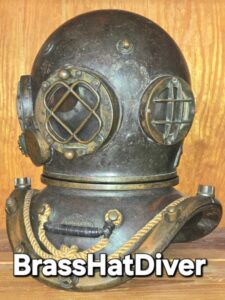
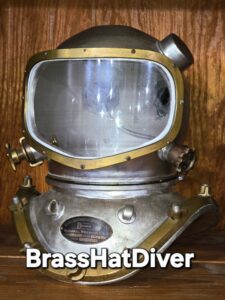
World War II shifted the focus of the company to standard diving equipment production. The war effort brought large Navy contracts for diving equipment to DESCO. The company quickly became the largest diving equipment manufacturer in the world. DESCO made over 3000 Mark V and Navy Helium Helmets during this period. The company’s research and development roots were not overlooked by the government. DESCO was contracted by the Office of Strategic Services (forerunner of the CIA) to design and build a compact oxygen rebreather. The result was the DESCO B-Lung. This unit, for the first time, permitted divers to swim freely under the surface, in the manner of SCUBA divers today, but without producing bubbles, which might disclose their position. Other projects included the Browne U.S. Navy Diving Mask, The Browne Lightweight Suit (Bunny Suit), and the Buie Mixed Gas Helmet. The government contracts included not only conventional hard-hat gear, but also weightbelts, shoes, knives, tools, recompression chambers, and miscellaneous items. By V-J Day, DESCO was producing more diving equipment than any other company in the world.
By 1945 DESCO had its own pressurized wet tank for research and development. On April 27, 1945, Jack Browne used this tank to “dive” to still a new record depth of 550 feet of seawater. Mr. Browne used a U.S. Navy Lightweight Diving Suit (bunny suit) for the tank dive. As in the case of Nohl’s earlier dive, he breathed a heliox mixture under the supervision of Dr. End. Both dives were milestones in the development of modern techniques of mixed-gas diving. During this time Max Nohl left DESCO to pursue other interests. He would return briefly in the early 1950’s.
In 1945 the company’s name changed to Diving Equipment & Supply Co. The end of the war brought a slowdown in the diving market. Foreseeing this situation the company had begun moving into the recreational market. Products included surf boards, water skis, masks, fins, the DESCO Airmaster SCUBA regulator, and recreational rebreathers.
In 1947 Jack Browne and Norman Kuehn sold the company to Alfred Dorst, E. M. Johnson, Paul Hoffman, and Irwin Knoebel. Johnson was general manager of DESCO during the war. Max Nohl at the time was looking to calm down his life a bit and he accepted an offer to return to DESCO as a technical advisor.
After the Korean War, which again brought an increase in U.S. Navy contracts and orders, the ownership changed hands several times, and by 1960 it went out of the sporting goods business. Ever since, it has concentrated solely, as it did at the start, on the design and manufacture of commercial and U.S. Navy diving equipment.
In May 1966, DESCO was purchased by Thomas and Marilyn Fifield. Mr. Fifield was an attorney and Mrs. Fifield served on several boards in Milwaukee. In 1968 DESCO moved to its present address at 240 North Milwaukee Street in Milwaukee. Mr. Fifield was responsible in the 1960’s for the design and development of the DESCO Diving Hat, which remains a standard piece of modern equipment for diving with air in relatively shallow water where mixed gases are not needed. Also the company has continued to improve and manufacture its famous DESCO Full-Face Mask, which originated in the early design efforts of Jack Browne and Max Nohl. This mask has probably been used in more total hours of commercial diving than any other piece of equipment ever made.
The company ownership changed again in 1997 with the purchase of DESCO from Mr. Fifield by Richard Koellner. Under Mr. Koellner the company has expanded its representation of other firm’s products that complement DESCO’s product line.
SNEAD CO.
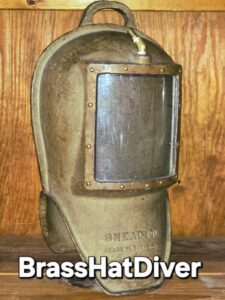
Founded in 1849, SNEAD & COMPANY IRON WORKS, of Louisville, Kentucky, was a cast-iron works business that manufactured just about everything. The Snead Manufacturing Building was located at 817 West Market Street on the western boundary of the central business district of the City of Louisville. The building was located on a portion of land that had been owned by the Snead family for several years.
The site of the Snead Building was, in the 1840s, the location of the Market Street Architectural Iron Foundry, which had then had several owners. In 1849 the foundry was purchased by Samuel P. Snead, a son of John S. Snead, prominent Louisville merchant and the organizer and first president of the Bank of Louisville. In 1851 Samuel Snead sold the foundry to Isaac Raphael, a successful dry goods merchant, who placed it in trust for his daughter, Martha Snead, wife of Charles S. Snead &, also a son of John Snead. Charles Snead Became manager of the iron works. According to an article in the Commercial Review in 1857, the Market Street Foundry was supplying cast iron for buildings in many Southern cities as well as in Louisville. By 1855 the company had changed its name to The Snead and Company Iron Works and Charles S. Snead became president of the firm. His son, Udolpho, was vice-president and another son, William, was general manager. The 1876 Atlas shows Snead and Company at the Market Street location.
The firm was one of the country’s leading manufacturers of ornamental and structural cast iron. Ads in city directories and business biographies attest to the wide variety of cast iron products made by the firm. The company had contracts for work on major buildings in many parts of the country, including United States Customs Houses in Louisville, Cincinnati, and Minneapolis; the stairway in the Washington Monument; both structural and ornamental iron work for the State, War, and Navy Building in Washington (now the Executive Office Building); and iron work for the Auditorium Building in Chicago, designed by Adler and Sullivan. Iron work by the Snead Company can still be seen on many Louisville buildings, especially on Main Street. Numerous manhole covers bearing the Snead name are extant along Louisville streets and sidewalks
The Snead and Company Iron Works operated on the Market Street site until it was destroyed by fire in 1898. The company’s operations were reestablished in New Jersey, and Udolpho and William Snead moved east to manage the company. In 1919 their name was shortened to SNEAD & CO. and their office & works were located at the foot of Pine Street, reached by Central R.R. of N.J. Pacific Avenue Station. Over the years the company has produced many different items, including bookends, lamps, window frames, tea kettles, propeller shafts, library bookstacks, dive helmets, coalhole covers, and so much more. Certain specialties were sold directly to the consumer by mail. Snead is well known for revolutionizing the way shelving was done in libraries, generating hundreds of miles of new shelf space. They dominated the bookshelf industry for two generations. Bookshelves from the company can still be found in the Library of Congress and countless older libraries around the world.
The E. J. Willis Company was established in 1888 and was a boating supply company based in New York. Willis produced various catalogs of nautical supplies and in some of these catalogs they listed a WILLIS DIVING HELMET. It is believed that they supplied shallow water helmets made by SNEAD, marketed as WILLIS.
GRISWOLD
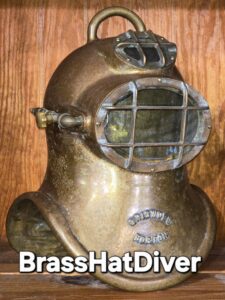
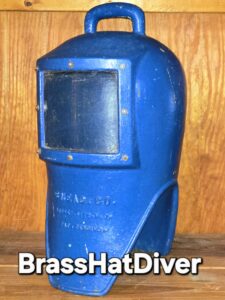
Charles Earl Griswold (1935-1996) was a lifelong inventor, practical field hand and designer of odd and unusual items. Although the Griswold Helmet was completely designed, created, and cast in Seattle, Washington, Chuck chose to have the location BOSTON on the helmet because “all diving helmets come from Boston.” The helmet was originally cast in iron and 12 units of iron helmets were made and sold before 1974. 2 bronze helmets were cast in 1974. The next 4 bronze helmets were not made until 1989, after Chuck had “retired” from active water work. In 1994, he determined to cast and market more helmets in response to inquiries resulting from its inclusion in Best Publishing Company’s book A Pictorial History of Diving.
In Chuck’s own words, “This hat had to look like it belonged in the sea and circular windows had been built into most of the helmets in the world. I had always been fond of the 60-degree isometric ellipse as a design element–turtles and clams had used it for eons, so that became the shape of the windows and the handle. The constraints of foundry practice eliminated side windows. Having logged a lot of hours in small three windowed helmets, I had learned to use the side lights as a top port, so I thought by tilting to the side a top window might serve for a glimpse to the side, particularly handy on ascent. That also answered the requirement for an auxiliary light. While lexan polycarbonate is used in many working hats it never looked clean. I knew that would be a strike against the helmet by my fastidious decorator friends. The best practical alternative was 1/4 inch thick auto safety plate with the shatterproof layer in the middle. That had worked well on a number of jobs, using clear “G E” silicone sealer to bed the glass in the casting. The glass is clamped in place with brass guards screwed down in four places.”
Another nice touch to the helmet’s design is its squared back, which allows it the capability to sit solidly on deck in a moderate sea.
L. G. HAMMOND
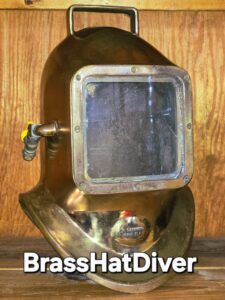
The Hammond shallow water is a Miami made diving helmet designed by Louis Hammond in 1978. Less than 25 of these hats were produced, all being made of cast brass and weighing almost 75 lbs. These helmets were specifically designed for a tourist attraction to do underwater walks in the Dutch Antilles. This helmet is very high on our list of favorites to dive. Since it’s cast brass, it doesn’t require any additional weights. This hat can easily and comfortably be worn by anyone, unlike other cast helmets, like the Sneads, this one has an extra wide breastplate area. The port on the hat protrudes out giving plenty of headroom and the ability for the individuals with glasses to wear them in the helmet. The large, flat window gives fantastic vision both outside and inside the helmet, which was perfect for taking pictures of tourist while they were on their underwater walk.